.png)

The Five-Legged Chair :: A More Empowering Way to Grow Your Practice

By Kelly Margani
Most lawyers I work with are stronger at business development than they think.
But they rarely see it that way—because they’re measuring themselves against a narrow, outdated idea of what BD ‘should’ look like, usually, one that centers on a single skill or character trait: the charismatic rainmaker, the networking machine, the always-on promoter.
If they’re not naturally wired that way, they assume they’re ‘bad’ at BD.
But here’s the thing ::
Relying on just one skill, tactic, or way of being? That’s a kickstand.
It might keep things upright for a while. It can even look like progress—especially early on. But it’s not built to carry the weight of a growing, evolving practice. The moment you want to build something bigger, more self-sustaining, more resilient, and bigger than yourself, you’ll need more.
So here’s the reframe I offered a client in one of our recent coaching sessions:
A sustainable practice doesn’t rest on one pillar. It’s supported by a foundation built from multiple, interconnected strengths that hold you up and move you forward. Think of it like a five-legged chair.
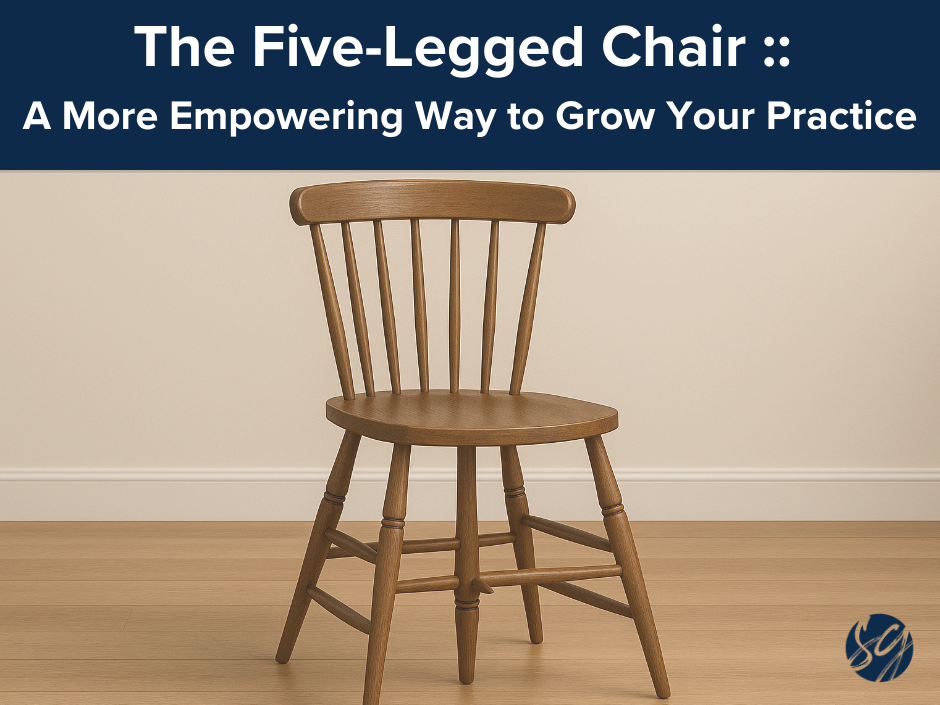
Each leg represents one pillar of business development that contributes to a self-sustaining, thriving practice over time. If one leg is a little wobbly, that’s not failure—it’s opportunity. The chair still holds. Your practice still functions. The key is knowing which leg needs strengthening and how to do it strategically.
Here are the five pillars of business development we looked at:
1. Organic Community Network ::
This is the BD you’re already doing without calling it BD. It’s your (or your kid’s) hockey league, golf club membership, volunteer board, or community association. The spaces where you show up consistently, share common ground, and build trust naturally. For many lawyers, this is the most authentic and least ‘salesy’ way to grow visibility. And they grow it doing things they love to do, showing up as themselves and being around like-minded people who share their interests.
2. Current Client Relationships :: Your work speaks volumes. When you consistently deliver excellence and build trust with clients, they not only come back—they become your biggest advocates. This pillar is about exceeding expectations and turning client service into future opportunity.
3. Internal Firm Referrals ::
Strong practices are often built from the inside out. Your reputation with colleagues and internal work-providers matters just as much as the one you have with clients. Are you known as someone who adds value, follows through, and makes others look good? That’s what keeps work flowing across desks and practice groups.
4. Practice Succession Opportunities ::
This is the quiet powerhouse of practice growth—the secret multiplier that often gets overlooked in practice-building strategies. Many of the most successful lawyers didn’t build their entire book from scratch—they inherited part of it from retiring partners. But succession doesn’t just happen. It takes positioning, internal relationships, and direct conversations. It’s one of the smartest plays a mid-career lawyer can make.
5. Net New Prospect Development ::
This is often the most intimidating pillar—the one that makes many lawyers double-down on the self-assessment that they ‘aren’t good at business development’. And it’s the one that needs the most intentional strategy. It’s about identifying and connecting with people who don’t yet know you, and creating pathways to trust. It’s a long game, but one that pays off when done thoughtfully and consistently.
Here’s the key ::
The common thread across every pillar is you. Not the work.
Your community knows you through shared experiences. Your clients know you through your responsiveness, reliability, and yes, exceptional work product. Your colleagues know you as someone who adds value and follows through. In all of those relationships, people are saying ‘yes’ to working with you—not just your skills, your practice area, or your legal knowledge.
But when you’re reaching out to someone who doesn’t already know you, that built-in trust isn’t there yet. That’s why your external business development efforts need to give new audiences a glimpse of the same version of you that others experience more organically.
That might look like:
Telling stories that show how you think, not just what you know
Sharing reflections or lessons from your day-to-day, not just your credentials
Letting your curiosity, integrity, humour, or compassion show through the surface
In other words, effective external BD isn’t about becoming someone else. It’s about amplifying the parts of you that already work—so that the people who don’t know you yet can start to trust that they want to.
So what do you do with all of this?
The point isn’t to be equally strong in all five areas, all the time. The point is to know where you stand in each at any given time—and focus on what you can do next to grow from there.
Because when you understand these five pillars, you can stop worrying about whether you’re ‘good’ at business development and start focusing on what really matters—fine-tuning the areas that are less strong, so you can create a solid, well-supported foundation. One that generates the work you want, for the people you want to do it for, not just now, but throughout your whole career.
Your chair is more stable than you think. Let’s make it stronger—one leg at a time.


Comments